Your Go To Market Strategy For Startups Playbook

A go-to-market strategy is your startup's detailed playbook for launching a product. It's the master plan that lays out precisely who your customers are, how you’re going to reach them, and what will give you an edge over the competition. This roadmap gets everyone—from marketing and sales to product and finance—rowing in the same direction for the biggest possible impact.
Building Your Foundation With Market Intelligence
Before you even think about writing ad copy or building a sales deck, you have to understand the world you're about to step into. A strong go-to-market strategy is built on a bedrock of deep market intelligence, not just gut feelings or assumptions.
This is all about swapping guesswork for real data to see the market as it actually is. Jumping ahead without this critical foundation is like setting sail without a map—you might be moving, but you're probably not heading toward success.

Honestly, this initial phase is where so many startups stumble. The sheer excitement to build and sell often overshadows the crucial need to listen and learn first. The goal here is simple: replace every "we think" with a confident "we know."
Define Your Ideal Customer Profile
Your first real task is to nail down your Ideal Customer Profile (ICP). An ICP isn't just a vague description; it's a highly detailed picture of the perfect company that would get the most value out of your product. This goes way beyond basic demographics.
To build a truly useful ICP, you need to get specific:
- Firmographics: Think industry, company size, location, and annual revenue. A B2B SaaS startup, for instance, might target "NYC-based tech companies with 50-200 employees."
- Technographics: What software and tools are they already using? This tells you a lot about their tech-savviness and potential for integration.
- Pain Points: What are the specific, measurable problems they're struggling with right now? Be precise.
- Goals: What are they ultimately trying to achieve? Is it boosting efficiency, driving more revenue, or maybe improving customer retention?
With your ICP set, you can then create more granular buyer personas. These are the semi-fictional characters within your ICP companies who actually make the buying decisions. Give them a name, a job title, and real-world motivations. For example, meet "Marketing Manager Maria," who's completely stressed about hitting her lead generation targets and reporting results to her CMO.
A classic startup mistake is trying to be everything to everyone. A laser-focused ICP ensures your limited resources are aimed squarely at the audience most likely to buy, become your biggest fans, and fuel that critical early growth.
Sizing Your Market Realistically
Now that you know exactly who you're targeting, you can figure out how big the opportunity actually is. This isn’t just about finding a massive number to impress investors; it's about understanding the tangible slice of the market you can realistically win. The standard way to do this is by calculating your TAM, SAM, and SOM.
This framework grounds your strategy in reality, forcing you to think about what's truly achievable.
Startup Market Sizing Framework
| Concept | Definition | Example (NYC-Based Coffee Subscription Box) |
|---|---|---|
| Total Addressable Market (TAM) | The total global demand for a product or service. | All coffee drinkers worldwide. |
| Serviceable Addressable Market (SAM) | The segment of the TAM your product targets within your reach. | All coffee drinkers in New York City who are open to subscription services. |
| Serviceable Obtainable Market (SOM) | The portion of the SAM you can realistically capture. | The percentage of NYC subscription coffee drinkers you aim to win in Year 1. |
Thinking through this progression helps you move from a broad vision to a concrete, actionable plan. A crucial part of this process is segmentation; to go deeper, it's worth understanding what market segmentation is and its key strategies.
Uncovering Opportunities With Competitive Analysis
Finally, remember that no startup exists in a vacuum. A thorough competitive analysis helps you understand exactly who you're up against and, more importantly, where their weaknesses are.
Don't just make a list of competitors. Dig deep. Analyze their product features, pricing models, marketing messages, and customer reviews to find the gaps you can exploit. This intelligence is absolutely crucial for positioning your product to stand out.
Don't just take my word for it. Companies that use a structured go-to-market framework see 10% higher success rates and 3x greater revenue growth. Just look at Spotify's early days. They targeted millennials with highly personalized playlists, a brilliant GTM move that let them carve out a dominant niche through precise segmentation.
Nailing Your Product Positioning And Messaging
You can have the most groundbreaking product in the world, but if you can’t tell a great story about it, it’s going to fall flat. That’s really what positioning and messaging are all about—they connect what your product does to why your ideal customer should actually care. Good positioning stakes out a clear territory in your customer’s mind, making your solution the no-brainer choice for their specific problem.
And let's be clear: positioning is way more than just a snappy tagline. It's the core story that informs every single thing you write and say, from the copy on your homepage to the script for a sales call. Get it wrong, and all your marketing efforts will feel disconnected and just won't land with the people you need to reach.

Crafting A Powerful Value Proposition
The heart of your positioning is your value proposition. Think of it as a super-concise promise: it tells a potential customer exactly how you’ll solve their problem and why you’re the best one to do it. It has to immediately answer their unspoken question: “What’s in it for me?”
To get this right, you need to nail three things:
- Relevancy: How does your product directly address your customer’s pain points? Be specific.
- Quantified Value: Show them the money (or the time, or the efficiency). Can you cut their workload by 50%? Can you increase their lead flow? Put a number on it.
- Unique Differentiation: What’s your secret sauce? Why are you the only real choice?
A weak value prop is generic and instantly forgotten. A strong one acts like a magnet, pulling in the right customers by showing them you understand their world.
From Positioning To Persuasive Messaging
Once you’ve locked down your positioning, it's time to translate it into messaging. This is the actual language—the words, phrases, and stories—you’ll use everywhere. The key here is relentless consistency. A customer should get the same core message whether they see a Facebook ad, read a blog post, or sit through a demo.
I always recommend creating a messaging matrix. It’s a simple but invaluable tool—just a grid that maps your key messages to each of your buyer personas. This ensures every piece of content speaks directly to their specific needs and motivations.
Take Descript, the audio and video editing platform. They didn't just sell software; they sold a smarter workflow. Their core message was "edit audio like a doc." It’s a simple, brilliant concept that instantly clicked with podcasters and YouTubers who were sick of wrestling with complicated editing tools. That sharp, targeted messaging was everything for building their passionate community.
This is a fantastic example of a startup go-to-market strategy paying off. Success stories like Descript show how community-driven buzz, fueled by targeted messaging, helps startups and creators break through the noise. It’s all about aligning your GTM with the buyer's journey—from first hearing about you to making a purchase—to drive that organic growth. Without that alignment, you just blend into the background.
This kind of cohesive messaging is a huge piece of your overall brand. To dive deeper into that, check out our guide on the essentials of branding for startups. When you get your story straight, every interaction you have with a customer builds on the last, strengthening their connection to your brand.
Choosing Your Sales And Distribution Channels
Once you've nailed down your positioning and messaging, it's time to figure out how you're actually going to get your product into the hands of the customers you’ve so carefully defined. This isn't just about logistics—it’s a massive strategic choice that will fundamentally shape your startup’s growth trajectory. The channels you pick and the sales motion you adopt will dictate everything from your customer relationships to your cost structure and, ultimately, your ability to scale.
Get this wrong, and it can be a painful, expensive lesson. I've seen startups try to force a high-touch, enterprise sales team on a simple, low-cost product and burn through cash like there's no tomorrow. On the flip side, expecting a complex B2B solution to just sell itself without any human guidance is pure fantasy. The real magic happens when you find that perfect alignment between your product, your price, and your audience.
Selecting The Right Sales Motion
Your sales motion is essentially the playbook your team follows to sell your product. For most startups, this boils down to one of three core models, and understanding them is the first step to building a solid plan.
-
Product-Led Growth (PLG): Here, the product does the heavy lifting. It's the primary engine for attracting, converting, and expanding your customer base. Think about how you started using Slack or Zoom. You probably signed up for free, saw the value almost instantly, and then upgrading felt like a natural next step. PLG is a great fit for products that are intuitive, have a lower price point, and can deliver a "wow" moment quickly.
-
Sales-Led Growth (SLG): This is the classic B2B model where a sales team actively prospects, nurtures, and closes deals. SLG is non-negotiable for complex, high-ticket products that require deep customer education, customization, or a long buying cycle. You can't sell enterprise cybersecurity software without a demo and a series of conversations.
-
Hybrid Model: Many of the most successful startups end up blending both approaches. A company might use a PLG freemium model to pull in thousands of small businesses, then have a dedicated sales team tasked with identifying the big fish—the enterprise accounts—swimming in that pool. This gives you the best of both worlds: broad reach and high-value deals.
The "right" motion isn't about what’s trendy; it’s about what your product demands. That cybersecurity platform for banks? It's going to be SLG, no question. A simple graphic design tool for freelancers? That's a perfect candidate for PLG.
Identifying Your Key Distribution Channels
After you've landed on a sales motion, you need to decide where you’ll connect with your audience. Whatever you do, don't make the classic startup mistake of trying to be everywhere at once. A smart go-to-market strategy focuses on the few channels that will give you the best bang for your very limited buck.
Just look at Zoom's explosion. Their frictionless freemium model was a PLG masterpiece. Anyone could jump on a call for free with just an email, experience how reliable it was, and then naturally invite colleagues to the next meeting. That viral loop, baked right into the product, became their most powerful distribution channel, way before they started pumping money into traditional marketing.
The best distribution channels often feel like a natural extension of your product and brand. Don’t just jump on a channel because your competitors are there. Pick the places where your ideal customers are already looking for answers and where you can genuinely make some noise.
To make a smart call, you need a solid framework for evaluating your options. A comprehensive startup digital marketing strategy is an absolutely essential piece of this puzzle.
A Practical Checklist For Channel Evaluation
Before you spend a single dollar, run every potential channel through this simple gut check. Score each one on a scale of 1 to 5 based on how well it fits your startup's reality.
| Criteria | Description | Example Question for an NYC-Based Meal Kit Startup |
|---|---|---|
| ICP Alignment | Does this channel actually reach your Ideal Customer Profile? | Do busy young professionals in NYC really use Instagram to find new food services? |
| Cost to Acquire (CAC) | Can you sustainably afford the cost to acquire a customer here? | What’s the likely cost-per-click for "healthy meal delivery NYC" ads on Google going to be? |
| Reach Potential | How big is the audience you can realistically access through this channel? | How many people in our target demographic can we reach through local NYC foodie influencers? |
| Control & Scalability | How much control do you have, and can you easily ramp up your efforts if it works? | If our local SEO efforts start paying off, how quickly can we double down? |
This kind of structured thinking shifts you from a scattered "let's throw spaghetti at the wall" approach to a focused, data-informed plan. By methodically identifying, testing, and prioritizing the right channels, you build a go-to-market engine that's both efficient and ready to scale.
Nailing Your Pricing and Packaging Strategy
Pricing is one of the most powerful, and most often neglected, parts of your entire go-to-market plan. It’s so much more than just a number on a page. Your pricing communicates your product's value, signals who your ideal customer is, and can either stall your growth or become a massive accelerator.
Too many founders get stuck in a couple of common traps. They either tally up their costs and slap on a margin, or they just glance at a competitor's website and copy their numbers. These shortcuts feel easy, but they completely miss the most critical element: the actual, tangible value your customer gets from using your product.
Choosing Your Core Pricing Model
First things first, you need to decide on the logic behind your price tag. This isn't just about the number; it’s about the philosophy that will guide how you earn revenue and grow with your customers. While you can get fancy later, most startups start with one of three fundamental approaches.
-
Cost-Plus Pricing: This is the most basic model. You figure out what it costs you to deliver your product and add a profit margin. It's simple, sure, but it has a huge blind spot—it completely ignores what the market is willing to pay or how much value you're actually creating.
-
Competitor-Based Pricing: Here, you set your prices based on what your rivals are charging. This can feel like a safe bet, especially in a crowded space. The danger? It often leads to a "race to the bottom" on price and makes it much harder to stand out based on your unique strengths.
-
Value-Based Pricing: This approach anchors your price to the value your product delivers. Think increased revenue, saved time, or reduced risk for your customer. It takes more work because you need to deeply understand your customers' pain points, but it has by far the highest ceiling for revenue.
For most tech and SaaS startups, value-based pricing is the way to go. It forces you to have honest conversations about the results you deliver, shifting the focus from your features to their outcomes.
The biggest mistake I see is founders who "set it and forget it." Pricing isn't a one-and-done task. It's a living, breathing part of your strategy that you should revisit and test at least once a year as you learn more about your customers and your product matures.
Structuring Tiers That Encourage Growth
With a pricing model in hand, it's time to package your product. Tiered pricing is a classic for a reason—it lets you cater to different types of customers, from small teams just kicking the tires to large enterprises. The secret is to design your tiers so that upgrading feels like the natural next step.
Here’s a proven structure that works wonders for SaaS companies:
-
The "Hook" (Freemium/Basic Tier): This is all about getting users in the door. It should offer just enough core functionality for someone to have that "aha!" moment and see the value. A project management tool might limit this tier to three projects or two team members.
-
The "Workhorse" (Pro/Business Tier): This is where you'll make most of your money. It’s built for your ideal customer and unlocks the key features they need to do their job effectively—things like advanced analytics, critical integrations, or better support.
-
The "Whale" (Enterprise Tier): This is your high-touch, custom plan. It’s a "Contact Us" tier for large companies that need things like dedicated account managers, beefed-up security compliance, or custom service-level agreements (SLAs).
Don't forget the psychology. Always highlight your most popular plan—usually that middle tier—to guide new customers. And make sure your tiers are built around a clear value metric, like the number of users, contacts, or data usage. As your customer's business grows, their usage of that metric will grow too, making the upgrade a logical and painless decision.
6. Building Your Launch Timeline And Gaining Initial Traction
All that planning and strategy has led you here—to the launch. This is the moment your go-to-market plan moves from paper to the real world. A great launch isn’t just about flipping the “on” switch; it’s about creating a wave of momentum that can carry your startup for months.
The real goal isn't just to "go live." It's about orchestrating a memorable event that grabs attention, sparks conversation, and pulls in those crucial first customers. Success at this stage comes down to meticulous preparation.
This timeline gives you a solid visual of the key phases for a successful product release.
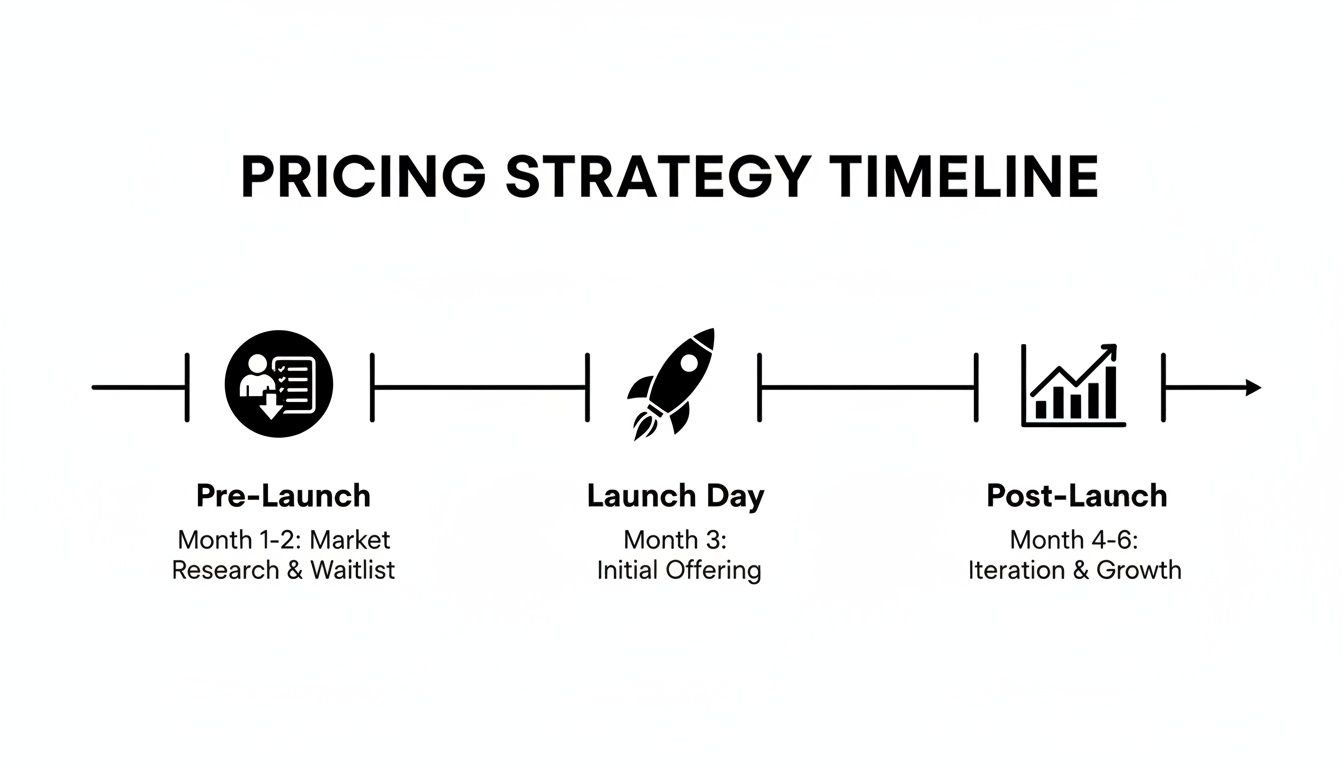
As you can see, the real work begins long before launch day and continues well after. It's a constant cycle of getting ready, executing the plan, and then refining your approach based on what you learn.
Setting The Stage Before You Launch
The weeks leading up to your launch are your golden opportunity to build anticipation. This pre-launch phase is all about warming up your audience so they’re excited and waiting on day one.
A fantastic first move is to build a waitlist. This does more than just collect emails; it validates real demand and helps you build a community before you've even sold anything. Sweeten the deal by offering early access, exclusive content, or a special launch-day discount for signing up. If you're new to this, we have a deep-dive guide on how to build an email list that actually converts.
Getting beta testers involved early is another game-changer. These are your first friendly users who will kick the tires, uncover bugs, and give you brutally honest (and priceless) feedback on everything from your messaging to the user experience. Their insights let you make critical tweaks before you face the wider market.
Your Launch Day Playbook
When launch day arrives, you need a crystal-clear, minute-by-minute plan. This is not the time for winging it; every task should be scheduled, assigned, and ready to go. To make sure your launch truly lands and gets you that initial traction, you need a solid marketing game plan. You can find some great ideas in this breakdown of Top Marketing Strategies For A Startup.
Your launch day should be a coordinated push across several channels:
- Press & Media: Get your press kit and a personalized pitch out to a hand-picked list of journalists and bloggers in your niche. Send it a few days before launch under an embargo so they have time to prepare a story.
- Social Media: Have all your posts, images, and videos queued up. Be ready to engage with every single comment and share, and rally your team and early believers to help spread the word.
- Email Blast: The moment you're live, hit "send" on an announcement to your waitlist, reminding them of the exclusive offer you promised.
- Community Posts: Share your launch on relevant platforms where your ideal customers gather. Think Product Hunt, niche subreddits, or specific industry forums.
To help you visualize this, we've mapped out a sample timeline that ties all these activities together.
Sample Startup Launch Timeline And Checklist
A structured timeline is your best friend for a smooth launch. It keeps everyone on the same page and ensures no critical tasks fall through the cracks. Below is a simplified 3-month GTM checklist to give you a framework you can adapt for your own startup.
| Phase (e.g., 90 Days Out) | Key Marketing Activities | Key Product/Sales Activities | Success Metric |
|---|---|---|---|
| 90 Days Out | Finalize core messaging & positioning. Create landing page with waitlist signup. Start foundational SEO & content creation. | Finalize beta version of the product. Recruit & onboard beta testers. Define ideal customer profile (ICP). | 500+ waitlist sign-ups. |
| 60 Days Out | Begin pre-launch content marketing (blog posts, social media). Identify & start engaging with key influencers/journalists. | Gather & analyze beta tester feedback. Prioritize bugs & feature requests. Develop initial sales collateral. | 20% month-over-month waitlist growth. |
| 30 Days Out | Prepare all launch day assets (email copy, social posts, press kit). Schedule social media & email campaigns. | Implement critical feedback from beta. Finalize pricing & packaging. Train sales/support team on the product. | Launch assets finalized & approved. |
| Launch Week | Execute social media blitz. Send press releases & pitches. Announce on Product Hunt & relevant communities. | Monitor site/app performance. Respond to all inbound customer inquiries & feedback. | 100+ new signups/sales in first 48 hours. |
| 30 Days Post-Launch | Share early wins & testimonials. Run retargeting ads. Send follow-up surveys to first customers. Analyze launch channel data. | Actively collect user feedback for V2. Monitor user engagement metrics. Refine sales process based on data. | 15% conversion rate from trial to paid. |
This checklist is just a starting point. The key is to think through each phase, assign ownership, and set clear, measurable goals for what success looks like at every step.
Keeping The Momentum Going
The launch isn't the finish line; it's the starting gun. The real work begins the day after, when you shift your focus from creating that initial splash to building sustainable growth.
Your number one priority is to gather feedback. Get on the phone with your first customers. Send out simple surveys. Find out what they love, what’s confusing, and what they wish your product could do. This feedback is pure gold for your product roadmap and your next marketing campaigns.
Finally, iterate. Fast. A startup's biggest superpower is its agility. By listening closely to your early adopters and adapting quickly, you can turn that launch day excitement into a long-term growth engine.
Measuring Success And Iterating Your Strategy
Your go-to-market plan isn't a "set it and forget it" document. Think of it as a living playbook that needs to evolve based on what you learn from your first real customers. To do that right, you have to look past the vanity metrics—like social media likes or website visits—and get serious about the numbers that actually signal the health of your startup.
The founders who really succeed are the ones who become obsessed with a few key performance indicators (KPIs). These are the metrics that tell you, without any sugarcoating, if your GTM strategy is actually working.
The Non-Negotiable Metrics to Track
At the bare minimum, every startup founder should have a dashboard tracking these three numbers. They’re your vital signs.
-
Customer Acquisition Cost (CAC): Simply put, how much money do you have to spend to get one new paying customer? You calculate this by dividing all your sales and marketing costs by the number of new customers you brought in during that period.
-
Lifetime Value (LTV): This is your best guess at the total revenue a customer will bring in over their entire time with your business. For a healthy, sustainable company, your LTV needs to be much higher than your CAC.
-
Churn Rate: What percentage of your customers are leaving you each month or year? A high churn rate is a massive red flag. It’s screaming that you have a problem with your product, your pricing, or the customer experience you're delivering.
Watching these metrics like a hawk gives you a brutally honest look at how things are going. Is your CAC creeping up? Maybe that ad channel you love is getting too expensive. Is your LTV to CAC ratio below 3:1? That’s a serious warning sign that your business model might not be sustainable in the long run.
Your data tells a story. The goal isn't just to collect numbers but to understand the narrative they're revealing about your customers and your market. Are you acquiring the right people? Are they sticking around? That’s what matters.
This obsession with data is what separates guessing from smart iteration. Instead of throwing things at the wall to see what sticks, you can make informed calls. You’ll know when to tweak your messaging, adjust your pricing, or pour more fuel on your most profitable acquisition channels, constantly sharpening your GTM strategy for real impact.
Common Questions Answered
Even with the best playbook in hand, you're bound to have questions as you build out your go-to-market strategy. I've seen startups get stuck on the same few points over and over, so let's clear up some of the most common ones right now.
What's the Real Difference Between a GTM Strategy and a Marketing Plan?
Think of it this way: your go-to-market (GTM) strategy is the entire blueprint for how your startup will launch a product and capture a piece of the market. It’s the master plan that involves everyone—sales, marketing, product, and support—and covers everything from pricing models to distribution channels.
Your marketing plan is a crucial piece of that puzzle, but it’s still just one piece. It’s the chapter that details exactly how you'll reach and communicate with your target audience, focusing on the specific tactics like content marketing, paid ads, SEO, and social media you'll use to generate awareness and bring in leads.
How Often Should We Actually Look at Our GTM Strategy?
Your GTM strategy isn't a "set it and forget it" document. The market shifts, your customers’ needs change, and your product gets better. You should be giving it a health check at least once a quarter to make sure it still makes sense.
Beyond that, you absolutely need to do a deep dive anytime something significant happens. This could be a major product update, a move into a new city or customer segment, or when your key performance indicators (KPIs) start flashing red. Flexibility is your biggest advantage as a startup, so don't be afraid to adjust your plan based on real-world feedback.
I see a few mistakes all the time. The biggest is not having a crystal-clear picture of the ideal customer. This trickles down into vague messaging and money burned on the wrong ads. Another classic is choosing a sales model that doesn't fit the product—like trying to force a high-touch sales process on a simple app that screams for a self-serve, product-led approach.
Finally, too many founders treat their launch like a finish line instead of the starting gun. They don't build up the hype or plan the execution, missing a golden opportunity to create that vital early momentum. A solid GTM plan helps you sidestep these common traps from the very beginning.
A powerful Web Design at NY website is the foundation of any killer go-to-market strategy, turning that first wave of launch traffic into loyal customers. Let us build the digital home your startup needs to scale. Explore our web design and SEO services today.