A Modern Guide to Real Estate Website Lead Generation


Real estate lead generation is all about turning casual online browsers into actual clients. It’s the art of drawing potential buyers and sellers to your website and, crucially, getting their contact information. This isn't just about having a pretty website; it’s a strategic mix of smart design, genuinely helpful content, and well-placed calls-to-action that creates a reliable pipeline of qualified leads. If you want to build a modern, scalable real estate business, this is a skill you have to master.
Building Your High-Conversion Website Foundation
Think of your website as your digital office. It's often the very first impression you make, and in real estate, that first impression is everything. Before you can even think about capturing a lead, your site has to be inviting, trustworthy, and dead simple to use.
This is the bedrock of your entire lead generation strategy. If the foundation is weak, everything you build on top of it—your ads, your content, your SEO—will eventually fall apart. A high-conversion website isn't about flashy animations; it's about crafting a smooth user experience (UX) that naturally guides people from "just looking" to taking the next step.
The first thing to accept is that most of your visitors are on their phones. Over 58% of all website traffic now comes from mobile devices, and I'd bet that number is even higher for local searches like "homes for sale in Astoria, Queens." You have to operate with a mobile-first mindset. That means your site should look and work perfectly on a phone, then adapt to a desktop—not the other way around.
Prioritize Speed and Mobile Experience
In real estate, speed builds trust. A slow website is a conversion killer, plain and simple.
If a potential buyer has to wait more than a couple of seconds for listings to load, they're gone. They've already bounced and are on your competitor's site. Don't just take my word for it; Google's data shows that the chance of a visitor leaving jumps by 32% as a page takes from 1 to 3 seconds to load.
To keep things fast and fluid, you need to nail these basics:
- Optimized Images: Of course you need gorgeous, high-resolution property photos. But they must be compressed. Huge image files are the #1 reason real estate websites crawl.
- Responsive Design: Your site needs to look great on any screen. It has to automatically resize and reformat for a giant monitor or a small smartphone, without any awkward pinching or zooming.
- Clean Code: A website built with clean, modern code is simply faster. It's also less likely to have bugs and glitches that frustrate users and make you look unprofessional.
- Reliable Hosting: This is not the place to cut corners. Good hosting means your site stays online, loads quickly for local users, and can handle a sudden rush of traffic when you have a hot listing.
Here’s a good rule of thumb: A visitor should be able to land on your homepage, search for a property, and view the details in three taps or less on their phone. If it’s any clunkier than that, you're losing people.
Design for Intuitive Navigation
A confused visitor will never become a lead. When someone arrives at your site, they need to know exactly what to do next without having to think about it. Keep your navigation simple and logical. Forget trying to be clever with menu labels—clarity is king.
For example, think about the different clients you serve. Someone looking to buy in Sunnyside, Queens, should immediately see a "Neighborhoods" or "Communities" tab. Clicking that should take them to a dedicated Sunnyside page with current listings, local market stats, and maybe a little write-up about the area. This structure not only gives the user what they want but also tells Google you're an authority on that neighborhood. To get this right, you really have to understand how to improve website conversion rate by designing clear user journeys.
Your navigation's main job is to funnel people toward the most important pages. Make sure these are front and center:
- Property Search: This has to be the most obvious thing on your homepage.
- Featured Listings: Instantly grab attention by showcasing your best properties.
- Neighborhood Guides: Build out robust pages for your key areas, like Long Island City or Jackson Heights.
- Buyer & Seller Resources: Give them something valuable, like a mortgage calculator or a home valuation tool.
Nailing this foundation creates a website where every visitor feels guided and understood. That's how you build the trust needed for them to hand over their contact information.
So you’ve got a killer website foundation. Now for the real challenge: turning all that anonymous traffic into actual conversations with potential clients. This is where the magic of real estate lead generation truly happens.
It’s about moving way beyond that generic "Contact Us" button and offering something genuinely valuable in exchange for a prospect's information.
Think of it this way: a beautiful website without clear conversion points is like a stunning open house with the doors locked. People can peer through the windows, but they can't come inside. Your job is to create compelling "keys"—what we call lead magnets—that prospects are actually excited to get their hands on.

This is a numbers game, but it's one you can heavily influence. Industry data shows that a typical real estate website converts visitors into leads at a rate of around 2.0–2.2%. That's not bad, but I've seen top-performing agents consistently pull in over 5% on pages they've optimized with powerful lead magnets. It's a game-changer.
Match Your Offer to the Visitor's Intent
Here’s a critical truth: not everyone visiting your site is at the same stage. A first-time buyer just dipping their toes in the water has completely different needs than a seller who wants to know what their home is worth right now. Your offers have to reflect that reality.
Offering a detailed home valuation to someone searching for "best schools in Queens, NY" is a total mismatch. It just won't work. Instead, you need a diverse portfolio of lead magnets, each tailored to a specific user intent.
Let’s break down a few proven examples:
-
For Early-Stage Buyers (Top of Funnel): These folks are in pure research mode. They crave information, not a sales pitch.
- Offer: A downloadable "Complete Guide to Buying in Queens" or a "Neighborhood Comparison Checklist."
- Why it Works: It provides high-level, valuable info that instantly positions you as the local expert, without being aggressive.
-
For Active Searchers (Middle of Funnel): These users are actively browsing properties and weighing their options.
- Offer: "Get Instant Access to Off-Market Listings" or "Sign Up for Daily Property Alerts in Astoria."
- Why it Works: This is all about exclusivity and timeliness. You're giving them an inside track that’s directly related to their active search.
-
For Ready-to-Act Sellers (Bottom of Funnel): These prospects are motivated and looking for a concrete reason to take the next step.
- Offer: A "Free, No-Obligation Home Valuation Report" or a handy "Seller's Net Sheet Calculator."
- Why it Works: It provides a tangible, personalized piece of data that helps them make a major financial decision.
The right lead magnet at the right time is crucial for guiding a prospect from casual browser to warm lead. Each offer should feel like the natural next step in their journey.
Lead Magnet Effectiveness by Funnel Stage
| Funnel Stage | Lead Magnet Example | Primary Goal | Best Placement |
|---|---|---|---|
| Top (Awareness) | Neighborhood Guide, Market Report | Build trust, establish authority | Blog posts, community pages |
| Middle (Consideration) | Custom Property Alerts, Case Study | Capture active searchers, showcase results | IDX search results page, property detail pages |
| Bottom (Decision) | Home Valuation Tool, Consultation | Generate high-intent leads | Seller landing pages, homepage CTA |
This table illustrates how different offers align with the user's mindset. By strategically placing these magnets, you create a seamless conversion path across your entire site.
A powerful lead magnet solves a specific problem or answers a specific question for your target audience. The more specific and valuable your offer, the higher your conversion rate will be.
Design Forms and CTAs That Encourage Action
Even the world's best lead magnet will fall flat if the process of getting it is clunky or intimidating. This is where the design of your call-to-action (CTA) buttons and lead capture forms becomes absolutely critical.
First off, your CTAs need to be impossible to miss. Use action-oriented language and colors that pop against your site's background. Ditch the boring "Submit" button and try something that screams value:
- "Download My Free Buyer's Guide"
- "See My Home's Value Now"
- "Get My Custom Property Alerts"
Once they click, the form itself needs to be frictionless. I've seen so many agents lose leads because they ask for too much information upfront. Long, complicated forms are conversion killers. A fantastic technique to combat this is using multi-step forms, which break the process into smaller, bite-sized chunks.
For instance, step one might just ask for a name and email. Once they've made that small commitment, step two can ask for their timeline or property address. This approach feels way less daunting and consistently leads to higher completion rates.
Building your email list through these targeted forms allows you to create segmented nurturing campaigns. For a deeper dive into this, you can check out our guide on how to build an email list for more advanced strategies.
Finally, place these conversion points where they make the most sense. An embedded form for a neighborhood guide belongs right inside a blog post about that specific area. A pop-up offering a free home valuation might trigger when a user is about to leave your seller's resource page. Context is everything.
Dominating Local Search With SEO And IDX
You've got a great-looking website and some solid lead magnets. But what good are they if no one ever sees them? This is where getting serious about local search becomes a make-or-break part of your lead generation strategy.
For a real estate agent, showing up on page one of Google for a search like "homes for sale in Forest Hills" isn't just a vanity metric—it's a business necessity.
And the secret weapon for making that happen? It's something you already have access to: the Internet Data Exchange, or IDX. Too many agents think of IDX as just a tool to slap MLS listings onto their site. Big mistake. When you use it right, IDX turns your website into a content-pumping machine that search engines can't get enough of.
Turning Listings Into SEO Goldmines
Think about this for a second. Every single property listing that your IDX feed pulls in becomes a brand-new, indexable webpage on your site. Instead of a simple website with a dozen or so pages, you could suddenly have hundreds, or even thousands, of pages.
Each one of those pages is jam-packed with the exact hyper-local keywords, addresses, and details that your potential clients are searching for. It's a massive advantage. Your site can automatically churn out fresh content every single day as new properties hit the market.
To get the most out of this, you have to make sure your IDX is set up to create unique, SEO-friendly URLs and title tags for every listing. A generic URL is useless. What you want is a structure that looks like yourwebsite.com/listings/123-maple-st-astoria-ny-11102. That URL alone tells Google everything it needs to know about the page's content and its geographic relevance.
The heart of local real estate SEO is proving you have hyper-local authority. Your IDX feed is the engine that does the heavy lifting, proving you're the most relevant, up-to-the-minute source for property info in your target areas.
Creating Neighborhood Guides That Rank
Individual listings are fantastic for SEO, but they're also temporary. Once a home sells, that page loses its relevance. To build real, lasting authority and catch people who are still in the research phase, you absolutely must create dedicated neighborhood guides.
These aren't just blog posts; they are comprehensive, evergreen pages designed to be the definitive online resource for anyone even thinking about moving to that area. A truly effective guide combines your expert insights with live, dynamic data.
Here's what a killer neighborhood guide includes:
- Live IDX Listings: Embed a dynamic feed from your IDX showing everything currently for sale, for rent, and recently sold in that specific neighborhood.
- Your Local Insights: This is your chance to shine. Write about the neighborhood's vibe, the best schools, go-to restaurants, parks, and transportation quirks.
- Real Market Data: Pull in key stats like the average sale price, days on market, and price per square foot. Your IDX or MLS is often a great source for this.
- Rich Media: Don't just tell them—show them. Add plenty of high-quality photos and video tours of the neighborhood itself. This keeps people on your page longer, which is a big thumbs-up for Google.
This approach puts you directly in front of people making high-intent searches like "living in Long Island City" or "best neighborhoods in Queens for families." When they land on your page and find everything they need in one place, you've instantly established credibility and are in the perfect spot to capture them as a lead.
Building Trust With Local SEO Signals
Beyond the content on your website, Google looks for external signals to confirm that you're a legitimate, authoritative local player. Getting these off-page factors right is crucial for ranking in the local "map pack" and organic search results.
First up is your Google Business Profile (GBP). It needs to be perfect. That means your business name, address, and phone number (your NAP) must be identical everywhere it appears online. No exceptions. Fill out every single section, upload professional photos of your team and office, and make sure your primary category is set to "real estate agent."
Next, you need to actively chase client reviews. A steady stream of positive, 5-star reviews on your GBP is one of the most powerful signals in local SEO. It tells both potential clients and Google that you're an active, trusted agent in the community. If you want to get into the nitty-gritty, you can learn more about the most important local SEO ranking factors and see how they all work together.
Finally, a smart internal linking strategy ties it all together. From your neighborhood guides, link out to specific property listings in that area. From a blog post about "First-Time Homebuyer Tips in Queens," link to your main buyer resources page. This helps visitors find more of your content and, just as importantly, it helps Google understand the structure of your site and which pages you consider most important.
Using Automation And Smart Follow-Up Systems
Capturing a lead on your website is a huge win, but let’s be honest, it’s just the starting line. The real work—and where the commission checks come from—is in the follow-up. In real estate, speed is everything. A fast, relevant response can be the one thing that separates you from your competition and turns a click into a client. This is exactly where automation becomes your most valuable employee.
Think of a smart follow-up system as your tireless assistant. It works 24/7 to nurture relationships, provide value, and keep you top-of-mind, all without you having to manually send every single email or text. This isn't about spamming people; it’s about strategically delivering the right message to the right person at exactly the right time.
Set Up Automated Email Campaigns For Every Lead Type
A new lead who just downloaded your "First-Time Buyer's Guide" has completely different needs than a homeowner who requested a home valuation. A one-size-fits-all follow-up plan is a recipe for failure. This is where your CRM becomes your command center for creating segmented, automated email campaigns that speak directly to what each lead is looking for.
Let's walk through a real-world example. A user signs up on your site to save a search for two-bedroom condos in Astoria, Queens. Instead of just letting that lead sit there, your system should immediately kick off a tailored "drip campaign."
- Email 1 (Instant): A welcome email confirms their saved search. You could even include a link to a blog post you wrote on "What to Look for in an Astoria Condo" to add immediate value.
- Email 2 (2 Days Later): An email that automatically pulls in a featured condo listing in the area that perfectly matches their criteria.
- Email 3 (5 Days Later): A quick, personal-sounding check-in from you, offering to answer any specific questions about the Astoria market or set up a viewing.
- Email 4 (10 Days Later): An informative piece on local mortgage lenders you trust or a market update for the 11102 zip code.
This slow, steady process builds trust and establishes you as the local expert. To really make this hum, implementing solid marketing automation best practices for Real Estate is the key to streamlining your campaigns and making sure no opportunity slips through the cracks.
Deploy Chatbots For 24/7 Lead Qualification
Your website visitors have questions at all hours, not just between 9 and 5. An AI-powered chatbot is the perfect way to provide instant answers and qualify prospects around the clock.
Instead of a passive "Contact Us" form, a chatbot actively engages visitors the second they land on your site. It can handle common questions like, "What are the school ratings in this area?" or "Can I see more photos of this property?" But its real power lies in asking the qualifying questions that save you time.
A well-programmed chatbot can ask about a visitor's budget, their buying timeline, and whether they have a property to sell. By the time that conversation gets handed off to you, the lead is already warmed up and partially qualified.
This flow chart gives you a simplified look at how this all connects—from your IDX feed all the way to how you show up in local Google searches.
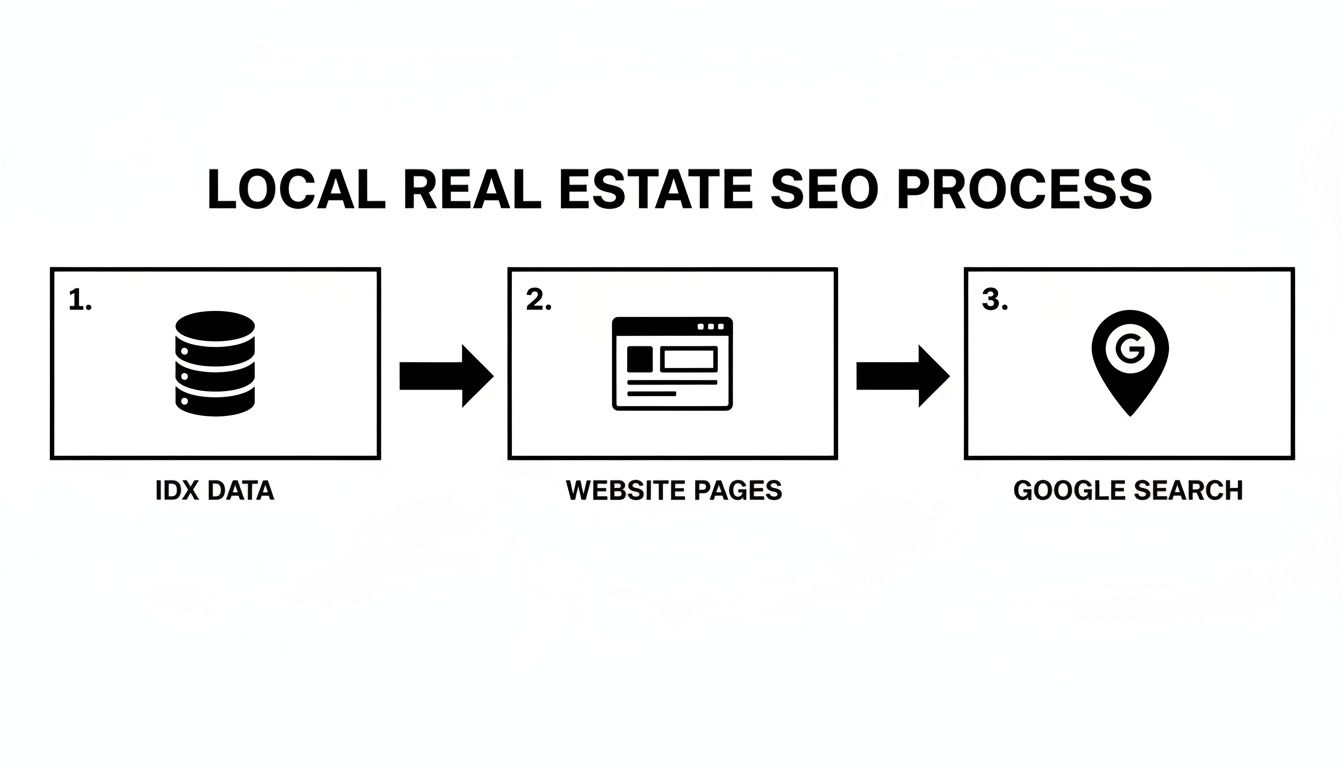
As you can see, your property data (IDX) is the foundation. It feeds your website with the content that fuels your visibility on search engines, creating a powerful, self-sustaining cycle for lead generation.
The impact of this technology is staggering. Some firms using marketing automation have reported a mind-blowing 451% increase in qualified leads. In the real estate world specifically, agents have seen a 60% jump in qualified leads while simultaneously cutting their operational costs by up to 60%. At the end of the day, automation isn’t about replacing you; it’s about freeing you up to do what you do best: build relationships and close deals.
Driving Targeted Traffic With Paid Advertising
Organic growth is your long game, the bedrock of a sustainable lead generation machine. But sometimes, you just need to get in front of motivated clients right now. That’s where a smart paid advertising strategy comes into play.
Paid ads on platforms like Google and Facebook are your accelerators. They deliver immediate, highly targeted traffic straight to the pages on your site that are built to convert. It's the difference between slowly building a reputation and buying a primetime commercial slot—both are critical for a balanced strategy.
Launching High-Intent Google Ads Campaigns
When someone types "three-bedroom homes for sale in Astoria Queens" into Google, their intent is screaming at you. They aren't just browsing; they're on a mission. Google Ads lets you put your website right at the top of the results for these exact, money-making searches.
Your goal isn't just to get clicks; it's to get qualified leads. To do that, every piece of your campaign has to work together seamlessly.
- Keyword Targeting: Get super specific. Forget broad terms like "NYC real estate." Instead, focus your budget on long-tail keywords like "condos for sale in Long Island City with a balcony" or "Forest Hills co-op under 500k."
- Ad Copy: Your ad needs to be a direct answer to their search. If they looked for Astoria homes, your headline better mention Astoria. Promise a specific benefit, like "See 20+ New Astoria Listings Instantly."
- Landing Page Experience: This is crucial. Never send paid traffic to your generic homepage. Clicks from your "Astoria homes" ad must go to a dedicated page showing only Astoria listings, with a clear, can't-miss call-to-action to register for more.
To really get the most out of your budget, implementing proven Google Ads lead generation best practices is essential for turning clicks into actual clients.
Creating Hyper-Targeted Facebook and Instagram Campaigns
While Google is great for capturing active searchers, social media ads let you find potential clients before they even realize they're looking. The targeting capabilities on platforms like Facebook and Instagram are incredibly powerful, allowing you to build an audience based on behaviors and interests that scream "future homebuyer."
Let's say you just listed a luxury two-bedroom condo in Flushing, Queens. You can run an ad campaign that targets an incredibly specific group:
- Location: People living within a 10-mile radius of Flushing.
- Demographics: Aged 30-55 with a household income in the top 10% of their zip code.
- Behaviors: Users who have recently visited Zillow, Realtor.com, or other real estate portals.
- Interests: People interested in luxury goods, real estate investing, or financial planning.
This kind of precision means your beautiful listing is only shown to people who are likely interested and can afford it. You're not just throwing money at the wall; you're making a calculated investment.
The real power of paid ads lies in retargeting. You can install a tracking pixel on your website to show follow-up ads to people who visited but didn’t convert, keeping your brand top-of-mind as they continue their search.
Retargeting to Re-Engage Lost Visitors
Get this: around 97% of people who visit your website for the first time will leave without taking any action. That's a huge pool of potential leads just walking away. Retargeting is your secret weapon for bringing them back.
By placing a small piece of code (a "pixel") on your site, you can anonymously "follow" your visitors around the internet. Let's say someone viewed three different listings in Jackson Heights and then left. The next day, you can serve them an ad on their Instagram feed showcasing another gorgeous Jackson Heights property.
This is wildly effective because you're no longer marketing to a cold audience. You're talking to people who have already raised their hand and shown interest. It keeps your name and face right in front of them while they're making their decision, dramatically increasing the odds they'll come back to you when they're ready to get serious.
Your Real Estate Lead Gen Questions, Answered
Jumping into website lead generation always stirs up a ton of questions. As the market and buyer expectations evolve, it’s smart to question if your strategy is still hitting the mark. Let's tackle some of the most common things agents ask so you can get clear, practical answers.
The biggest takeaway? Consistency is everything. Random efforts get random results. If you want a reliable pipeline of prospects, you need a steady, multi-channel approach.
How Much Should I Spend on Lead Generation?
This is the million-dollar question, and the honest answer is, "it depends." There's no magic number that works for everyone. A brand-new agent might start with a few hundred dollars a month on social media ads, while an established team in Queens could be investing thousands into Google Ads and a sophisticated CRM.
A much better way to think about it is by looking at your Cost Per Lead (CPL) and Return on Investment (ROI). Don't just pick a budget out of thin air; work backward from your goals.
- What's your target? First, figure out how many closings you need each quarter.
- What's your conversion rate? Be honest about your numbers. How many leads does it typically take to get one closing?
- Do the math. If you close 1 in 50 leads and you need two closings this quarter, you need 100 leads. Simple as that.
- Build your budget. If you know from experience that your average CPL on Facebook ads is $25, then your budget to get those 100 leads is $2,500.
This data-first approach takes the emotion and guesswork out of it. Start with a small, manageable budget, track your CPL on every channel (SEO, social, paid ads), and then double down on what’s actually bringing you the best return.
Should I Buy Real Estate Leads?
Buying leads can definitely feel like a shortcut to a full pipeline, and for agents just starting out, it can be a tempting way to get the phone ringing. But it's not a sustainable long-term strategy and it comes with some serious downsides.
The leads you buy are almost always cold. They've likely been sold to several other agents in your area, which means you're immediately in a footrace to be the first person to call. It’s no surprise that conversion rates on purchased leads are famously lower than the organic leads you generate through your own efforts.
Think of it this way: buying leads is like renting an audience for a night. Building your own website lead gen system is like owning the venue. Ownership gives you sustainable, long-term value and a much higher quality of prospect.
How Quickly Should I Respond to a New Lead?
The simple answer? Immediately. Five minutes ago would be even better.
The data on this is crystal clear and frankly, a little terrifying. Responding to an online inquiry within the first five minutes can massively increase your chances of actually connecting with and converting that person. Wait just 30 minutes, and the odds of qualifying that lead drop off a cliff.
This is exactly why automation isn't just a "nice-to-have" anymore; it's essential. The moment someone fills out a form on your site, an automated text or email needs to go out. This first touch buys you goodwill, confirms you got their request, and lets them know a real person will be in touch shortly.
Without that instant, automated response, you're starting every new relationship at a serious disadvantage.
At Web Design at NY, we build high-performance real estate websites designed to turn traffic into a predictable stream of exclusive leads. Our team combines expert SEO with conversion-focused design to create a digital foundation that works for you 24/7. Discover how we can help you own your online market by visiting us at https://www.webdesignatny.com.