Master Your Local Marketing Strategy for Business Growth

At its core, a local marketing strategy is your game plan for attracting customers right in your own backyard—a specific neighborhood, borough, or even a few city blocks. For any business in New York City, this isn't just a good idea; it's a fundamental requirement for survival and growth in one of the most competitive places on Earth.
Why a Local Marketing Strategy Is Your NYC Superpower
Trying to market a business in NYC with a broad, one-size-fits-all approach is like shouting into the wind in Times Square. Your message is just noise. A generic national campaign simply won't resonate with a Brooklynite hunting for the best bagel in Bushwick or a tourist in Midtown looking for an authentic slice of pizza "near me."
That's where a sharp, focused local marketing strategy becomes your secret weapon. It turns the city's overwhelming scale from a massive challenge into a genuine advantage.
Think of it like this: the big, faceless department store can never replicate the feeling of the corner bodega where the owner knows your order. Local marketing lets you become that trusted neighborhood spot, building real community ties that create loyalty and keep people coming back.
This infographic really drives home how a local focus can transform your business.
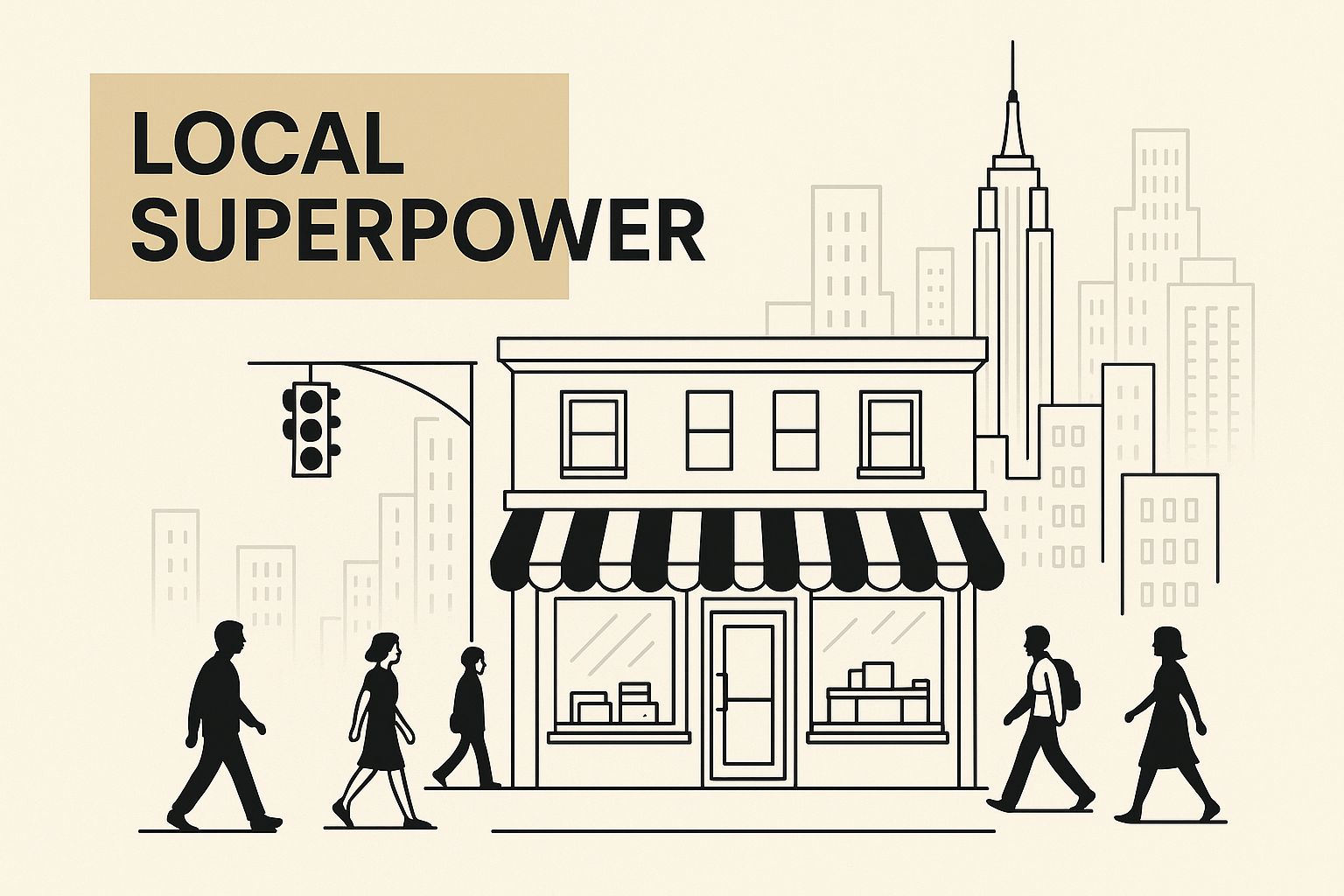
As you can see, it's not about a single tactic. It’s about weaving together multiple efforts that build trust with your neighbors and, most importantly, get them to walk through your door.
The Power of Proximity and Intent
Today’s customers are constantly searching for solutions right where they are. The data is staggering: local-focused queries now account for 46% of all Google searches. Even more impressively, 28% of those local searches result in a purchase.
And it doesn't stop there. Searches including the phrase "near me" have exploded by over 500% in recent years. People want convenience, and they want it now. This massive shift in behavior means being visible locally isn't optional anymore.
When someone pulls out their phone on your street, you need to be the first and best answer they find. That takes a smart mix of technical know-how and genuine community connection.
A strong local strategy ensures that when a potential customer is standing on your block, they find you—not your competitor two doors down. It's about winning the battle for attention right at your doorstep.
From Digital Signals to Foot Traffic
At the end of the day, the goal is simple: turn online searches into real-world customers. A well-crafted local marketing strategy bridges the gap between someone typing into Google and that same person walking into your shop.
It's about so much more than just having your address pop up on a map. It’s about embedding your business into the daily life of the community. The connection between a solid online presence and local relevance is undeniable, and as we'll explore, understanding how local SEO and web design work together is a critical piece of the puzzle.
Building Your Foundation with Four Core Pillars
A powerful local marketing strategy doesn't just happen. Much like a classic NYC brownstone, it needs a solid foundation—several strong pillars working together to create a lasting structure. If you neglect one, the whole thing can feel wobbly. But when you master all four, you build a business that becomes a true neighborhood fixture.
These four pillars are your blueprint for attracting and keeping local customers: Local SEO, Community Engagement, Localized Content, and Online Reputation Management. Let's break down each one to see how it works and why it’s so essential for any business trying to make it in the five boroughs.
Pillar 1: Local SEO Visibility
Local Search Engine Optimization (SEO) is all about making sure your business shows up when someone nearby is searching for what you offer. Think of it as getting your digital storefront on the main drag of Google, not tucked away on some forgotten side street. When you consider that a staggering 83% of customers use a search engine to find local businesses, you realize just how crucial this is.
Your most important tool here is your Google Business Profile (GBP). This is your digital front door. A fully optimized profile is non-negotiable—that means up-to-date hours, great photos, the right service categories, and a map pin that's actually in the right place. It’s often the very first impression you make and directly impacts how you rank on Google Maps and in "near me" searches.
Beyond your GBP, local SEO is about targeting neighborhood-specific keywords. Instead of just "bakery," you aim for "best croissants in the West Village" or "custom cakes Upper East Side." This focus connects you with people who are ready to walk in and buy something right now.
Pillar 2: Authentic Community Engagement
You can’t win at local marketing by simply being in a community; you have to be of the community. This pillar is about moving beyond simple transactions to build real, human relationships. It’s the difference between being a faceless business and being "that great coffee shop on the corner everyone loves."
Authentic engagement can take many forms:
- Sponsor Local Events: Get your business’s name on the back of a little league team's jerseys or sponsor a booth at a neighborhood street fair. This isn't just advertising; it's showing you care and building real goodwill.
- Form Local Partnerships: Team up with a non-competing business. A gym in Astoria, for example, could partner with a nearby health food store to offer mutual discounts. It's a win-win for both businesses and their customers.
- Get Involved: Join local business associations or community Facebook groups. Being an active, helpful participant—not just a self-promoter—establishes your presence and builds trust from the ground up.
This isn't about the quick sale. It’s about planting seeds of trust that grow into long-term loyalty and word-of-mouth referrals, which are still gold in any tight-knit NYC neighborhood.
Pillar 3: Localized Content Creation
Your content is your voice, and to connect with New Yorkers, it has to speak their language. This is all about creating blog posts, social media updates, and videos that reflect the unique character and daily grind of your local audience. Generic, corporate-style content just gets ignored here.
Localized content shows you understand the daily life of your customers. It proves you're a neighbor, not just another business trying to sell them something.
Instead of a bland post on "The Benefits of Yoga," a studio in Brooklyn could write "5 Best Post-Work Yoga Stretches for Dumbo's Tech Commuters." A Queens-based hardware store could create a video guide on "How to Maximize Your Tiny Apartment Balcony Garden." This kind of content isn't just more interesting—it also ranks better for the specific, long-tail search terms your actual customers are using.
Pillar 4: Proactive Online Reputation Management
In the world of local business, your online reviews are your currency. This final pillar is about actively managing what people are saying about you online. With over 90% of consumers reading reviews before making a purchase, you can't afford to leave this to chance.
This involves more than just crossing your fingers for good feedback. It means actively encouraging happy customers to leave reviews on platforms like Google, Yelp, and other industry-specific sites. A steady stream of recent, positive reviews is one of the strongest signals to both potential customers and search engines that your business is the real deal.
Just as important is how you respond. Thanking customers for positive reviews shows you appreciate them. Responding professionally and helpfully to negative feedback shows you care and are committed to getting it right. This active management can often turn an unhappy customer into a loyal one and shows everyone else that you stand behind your work.
These four pillars are the bedrock of any successful local marketing plan. They aren’t just separate tasks to check off a list; they support and amplify one another.
The Four Pillars of Local Marketing
| Pillar | Primary Goal | Example Tactics for NYC Businesses |
|---|---|---|
| Local SEO Visibility | Be found easily in local searches | Optimize your Google Business Profile. Target neighborhood-specific keywords (e.g., "Park Slope plumber"). Build local citations. |
| Community Engagement | Build trust and brand loyalty | Sponsor a local block party. Partner with a complementary business for a cross-promotion. Actively participate in community groups. |
| Localized Content | Connect on a personal level | Write a blog post about "The Best Dog-Friendly Patios in Astoria." Create a video tour of your shop and the surrounding area. |
| Reputation Management | Build a trustworthy online presence | Actively request reviews from happy customers. Respond to all reviews (positive and negative) on Google and Yelp. |
When you build on this foundation, you stop being just another option and start becoming a neighborhood institution.
Crafting Your Hyper-Local Marketing Plan
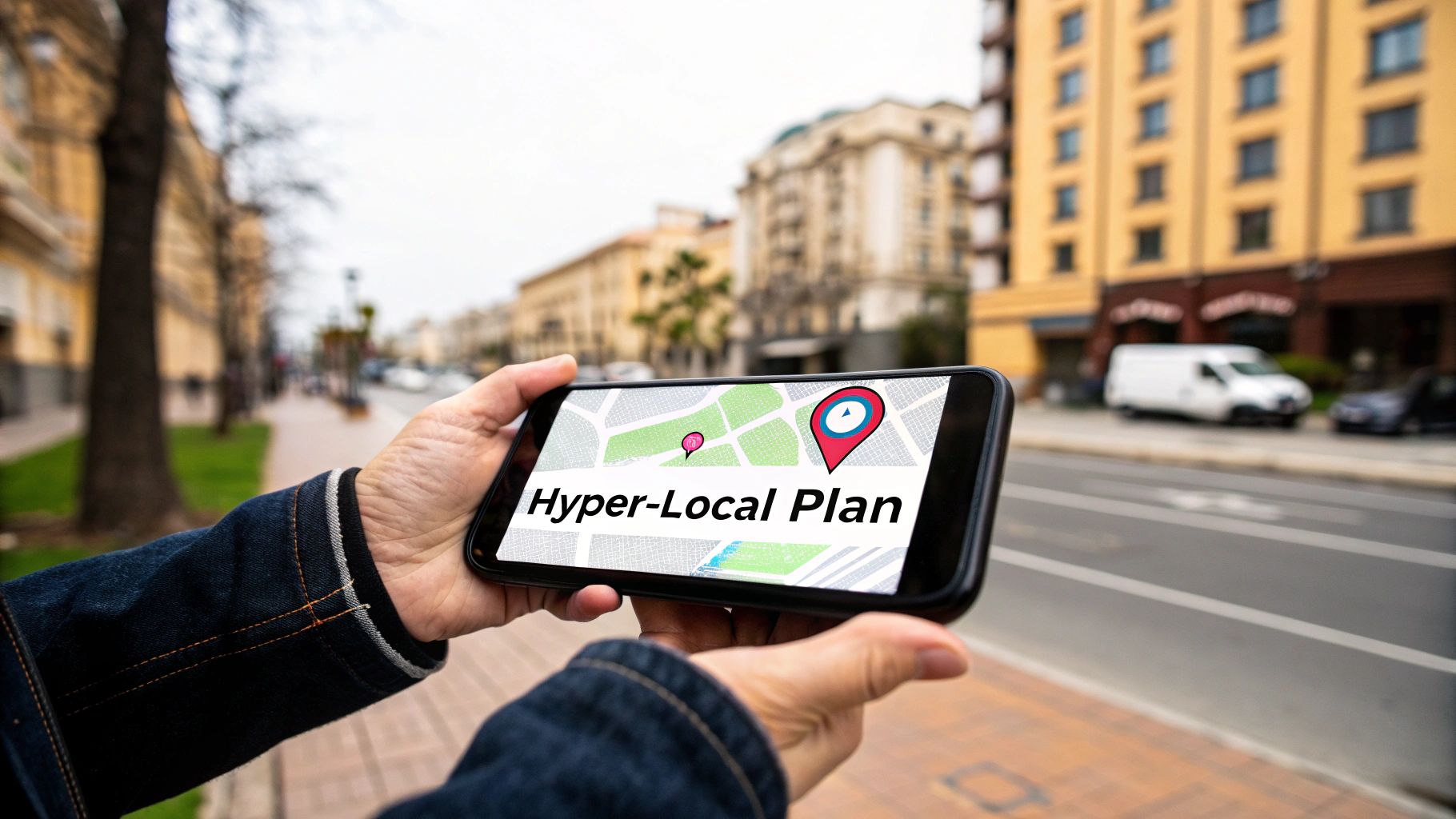
This is where the rubber meets the road—moving from big-picture ideas to a sharp, street-smart plan. A hyper-local strategy isn't just about targeting a zip code; it's about getting to know the unique micro-communities within your service area.
You have to see the difference between marketing to NYU students in Greenwich Village and young families in Park Slope. They might be just a subway ride apart, but they live in entirely different worlds.
Think of it like swapping a city-wide map for a detailed neighborhood blueprint. Instead of just seeing "Brooklyn," you start to see the specific blocks, subway stops, and local coffee shops that shape your customers' daily routines. This granular view is what transforms a generic ad into a personal invitation.
And this isn't just a trendy idea; it's a proven way to grow. Roughly 90% of marketers who tap into location-based marketing report a jump in sales, with 86% seeing their customer base expand. It’s a clear shift from casting a wide net to using a finely-tuned spear.
Analyze Your Local Competitors
Before you can carve out your space, you need to know who you're up against. Think of a local competitor analysis as your on-the-ground reconnaissance mission. Start by pinpointing the top 3-5 businesses in your immediate vicinity offering something similar to you.
What are they doing right? More importantly, where are they dropping the ball? Dig into their Google reviews, see what kind of neighborhood-specific stuff they’re posting on social media, and look for service gaps. These weaknesses are your openings to step in and offer something the community is clearly missing.
Set Hyper-Local and Measurable Goals
Vague ambitions like "get more customers" are a recipe for failure. A solid hyper-local plan needs concrete, measurable goals tied directly to the neighborhood you’re serving. This is what keeps your efforts grounded in reality.
Here are a few examples of what strong, hyper-local goals look like:
- Increase foot traffic from the 2nd Ave subway stop by 15% in the next quarter.
- Secure 20 new reviews from customers in the 10012 zip code this month.
- Boost online orders from the SoHo neighborhood by 25% using targeted social media ads.
Goals like these are not only easy to track, but they also force you to think about the specific tactics needed to hit them. They give you a clear benchmark for success and make it easy to justify where every marketing dollar is going. For an extra edge, dive into how schema markup for local businesses can help NY entrepreneurs.
A great hyper-local plan turns abstract marketing concepts into concrete actions. It's the difference between saying "we want more local business" and having a detailed plan to capture the lunch crowd from the office building across the street.
Master Geotargeting and Geofencing
These two tactics are the engine of any modern hyper-local strategy. They give you the power to deliver the right message to the right person, at the right place, at precisely the right moment.
-
Geotargeting: This is your digital flyer, but it only shows up on the phones of people within a specific area. You can serve ads to users by city, zip code, or even a single neighborhood when they search for what you offer. A key piece of this puzzle is creating winning location landing pages to convert that highly qualified traffic.
-
Geofencing: This is even more precise. It lets you draw a virtual "fence" around a physical location, like your storefront, a local park, or even a competitor's shop. When someone with a specific app on their phone crosses that line, it can trigger a notification or an ad—maybe a special offer to entice them to walk over to your place instead.
Used correctly, these tools turn your digital marketing from a shotgun blast into a sniper shot. You stop wasting money on people who will never visit and focus your budget only on those most likely to walk through your front door.
Creating Content That Speaks New York

Think of your content as your business’s voice. In a city like New York, that voice needs to have the right accent. A generic, one-size-fits-all message just gets lost in the shuffle. To actually cut through the noise, your content needs to feel like it came from a neighbor, for a neighbor.
This means ditching the bland stock photos for real, authentic pictures of your team at the local street fair or your storefront decked out for a community festival. It's about writing blog posts and social media updates that capture the unique energy of your borough or even your specific block. This is what a real local marketing strategy is all about.
Speak the Language of Your Neighborhood
Forget the stiff corporate jargon. Imagine creating content that plugs directly into the everyday lives of your customers. This approach doesn't just tell them you're local; it proves you get their world because you're living in it, too.
A coffee shop in Bushwick, for example, could put together a guide to "The Best Co-Working Spots Within a 5-Minute Walk." Or a pet groomer on the Upper West Side might write a blog post on the "Top 5 Dog-Friendly Patios Near Central Park."
This kind of content is more than a sales pitch—it offers real value to the community. It also does wonders for helping you show up in the super-specific Google searches your ideal customers are typing every day.
Your content should answer the questions your local customers are asking. It transforms your business from just another service provider into an indispensable community resource.
This focus on local culture isn't just a nice-to-have; it's essential. Research shows that 72.4% of consumers are more likely to buy from a brand that shows it understands them on a local level. This goes way beyond language—it's about knowing the local customs, the holidays, and the general vibe that makes your message feel like it belongs.
Build a Local Content Calendar
A solid plan is the difference between consistent connection and random posts. A local content calendar is your roadmap, helping you map out topics that will hit home with your audience all year long.
Here are a few ideas to get you started:
- Neighborhood Hero Spotlights: Profile a local artist, a well-known community leader, or even a loyal customer. It shows you’re invested in the people who make the neighborhood great.
- Local Event Coverage: Post about upcoming street fairs, farmers' markets, or charity runs. Follow up with photos and highlights to keep the conversation going with people who were there.
- Community Stories: Share stories that capture the spirit of your neighborhood. This could be anything from the history of a local landmark to how residents rallied for a cause.
- Partnership Promotions: Team up with other local businesses and create content that showcases your collaboration. It shows a united community front.
Planning ahead like this creates a steady stream of content that builds a genuine bond with your audience. To get everything organized, you might find it helpful to use a content marketing strategy template.
From Content to Community Connection
At the end of the day, localized content is all about building relationships. It’s the digital version of greeting a regular by name when they walk through your door.
This approach fundamentally changes how people see your business. You're no longer just a place to buy something; you become a vital, valued part of the community fabric. That kind of connection builds a level of trust and loyalty that a generic, city-wide campaign could never hope to achieve. It’s about being more than a business in NYC—it's about being a business that is truly of NYC.
Measuring What Matters for Local Success
https://www.youtube.com/embed/KMMnOv5t8kk
So, you've launched what feels like a brilliant local marketing strategy. That's a huge step, but it's only half the battle. How do you actually know if your efforts are bringing people through the door and not just creating a bit of online buzz?
To figure out your true return on investment, you have to look past the "vanity metrics" like likes and followers. A packed subway car doesn't mean everyone is getting off at your stop, right? In the same way, high social media engagement doesn't always lead to sales. You need to zero in on the actions that signal a customer is getting serious—walking into your store, calling your business, or visiting your website to buy something. Data is your best friend here.
Your Local Analytics Dashboard
One of the most powerful—and completely free—tools you have at your fingertips is Google Business Profile (GBP) Insights. This dashboard is a goldmine of information, showing you exactly how customers find and interact with your business online. It’s the very first place you should look to see if your local SEO efforts are hitting the mark.
Instead of drowning in a sea of spreadsheets, just focus on a handful of core metrics that paint a clear picture. These are the numbers that connect your online presence to actual, real-world business.
Here are the essential KPIs to watch in your GBP dashboard:
- Search Views: This tells you how many times your business popped up in search results. It’s a fantastic barometer for your overall visibility.
- Map Views: See how often people found your business on Google Maps. This is a huge indicator of local discovery.
- Website Clicks: The number of people who clicked from your GBP listing to your website. This is high-intent traffic, plain and simple.
- Phone Calls: GBP tracks every time someone clicks the "call" button, giving you a clean count of direct, immediate leads.
- Direction Requests: This one is pure gold. It measures how many potential customers asked Google for directions to your front door—a powerful signal of real-world foot traffic.
A smart local marketing strategy is built on data, not guesswork. When you track the right things, you stop spending money on what feels right and start investing in what you know for a fact works.
Connecting Clicks to Customers
While GBP Insights gives you a great look at your digital footprint, the real goal is tying those online actions to what happens in your store. This takes a little creativity to bridge the gap between a click and a paying customer.
It's simpler than it sounds. For instance, when you run a promotion, create location-specific coupon codes. If you're running a geotargeted ad for your West Village shop, use a code like "WV15OFF." Now you can directly trace sales back to that specific campaign and calculate a clear ROI.
You can also go low-tech. Use in-store surveys or just have your staff ask, "How did you hear about us today?" This one simple question can give you priceless feedback on which of your marketing channels are really making an impact.
Essential Local Marketing Metrics and Tools
Getting your metrics organized helps you see the whole picture. A simple tracking system lets you monitor your performance and make sharp, data-driven decisions to fine-tune your strategy over time.
Here's a quick look at the key performance indicators you need to watch and the tools to help you do it.
| Metric | What It Measures | Primary Tool(s) |
|---|---|---|
| Foot Traffic | The number of people walking into your physical location. | In-store counters, asking customers, location-specific coupons. |
| Local Search Rankings | Your business's position in search results for key local terms. | Google Search Console, third-party SEO tools. |
| GBP Interactions | Clicks, calls, and direction requests from your profile. | Google Business Profile Insights. |
| Online Reviews | The quantity and quality of customer feedback. | Google, Yelp, industry-specific review sites. |
| Lead Generation | The number of new contacts or inquiries from a campaign. | CRM software, contact form submissions, call tracking. |
By keeping a close eye on these areas, you can spot trends, put more fuel behind your winning tactics, and cut what isn't delivering. This is how you transform your marketing from a business expense into a predictable engine for growth.
Your Local Marketing Questions Answered
Even with the best game plan, jumping into a local marketing strategy always brings up new questions. It's only natural. For business owners in a place as intense as New York City, we see the same practical hurdles pop up time and time again.
This section is all about giving you direct, no-nonsense answers to the most common questions we hear. Think of it as your field guide for those "what now?" moments, designed to give you the clarity to make smart decisions and keep things moving.
How Much Should a Small NYC Business Budget for Local Marketing?
There's no magic number here, but a really solid rule of thumb is to set aside 5-10% of your total revenue for marketing. If you're just starting out, that might only be a few hundred dollars a month, and that’s perfectly fine.
Your first dollars should go to the absolute essentials. We’re talking about nailing your Google Business Profile and maybe running a few small, super-targeted social media ads in your immediate neighborhood. The whole idea is to start small and obsessively track what works.
A smart budget isn't about spending more; it's about spending smarter. Focus on high-impact, low-cost activities first, then reinvest what works back into your marketing.
Things like actively asking customers for reviews or creating content about your specific block or neighborhood cost you more in time than money, but the payoff is huge. Once you see those foundational efforts bringing people in, you can feel confident putting more money behind your ads.
What Is the Single Most Important Part of Local SEO?
If you're strapped for time and can only focus on one thing, make it your Google Business Profile (GBP). Period. Think of your GBP as the digital front door to your business on the world's biggest search engine. It’s the absolute foundation of your local presence.
Having a complete and active GBP isn't just a suggestion—it's non-negotiable. And I don't just mean listing your address and hours. A truly optimized profile involves:
- Completing Every Section: Fill out every single field with detailed, accurate info. Don't skip anything.
- Choosing Precise Categories: Pick the primary and secondary categories that perfectly describe what you do.
- Uploading High-Quality Photos: Constantly add new, real pictures of your shop, your products, your team—show people what you're about.
- Managing Reviews: Make it a habit to ask happy customers for reviews and respond professionally to all feedback, good and bad.
- Using GBP Features: Take advantage of tools like Google Posts to share updates or the Q&A section to engage directly with potential customers.
A profile that's active and well-cared-for sends powerful signals to Google that your business is legit, relevant, and trustworthy. That directly translates to better rankings in the local map pack and those critical "near me" searches, putting you right in front of people who are ready to spend money. If you want to dive deeper into this and other topics, there are plenty of additional marketing articles and insights out there that can help.
How Long Does It Take to See Local Marketing Results?
This is a big one, and the honest answer is: it depends on what you're doing. It’s best to think about this in two buckets: short-term wins and long-term growth.
Some tactics can deliver results almost right away. A well-designed local ad campaign on Google or Facebook can make your phone start ringing within a few days. Likewise, a special promotion sent to your email list can pack your store over a weekend.
Local SEO, however, is a marathon, not a sprint. In a market as competitive as NYC, it can realistically take 3 to 6 months to see a real, lasting jump in your organic search rankings. Building a killer online reputation and becoming a true part of your local community also takes time and consistent effort.
The best strategy is a balanced one that mixes both:
- Short-Term Tactics: Paid ads and special offers to get immediate business.
- Long-Term Investments: SEO, content, and community-building for sustainable growth that lasts.
This two-pronged approach makes sure you're getting customers in the door today while building a powerful foundation that will pay you back for years. Just remember to keep an eye on your progress so you know what's working and where to adjust.
Ready to build a local marketing strategy that puts your NYC business on the map? The team at Web Design at NY specializes in creating websites and SEO campaigns that attract local customers and drive measurable growth. https://www.webdesignatny.com