Small Business Web Design: small business web design that drives results


For a small business, a website isn't just about having an online address. It’s about creating a powerful tool built specifically to hit your company's goals, whether that’s getting local customers to call you or driving sales through an online store. It's far more than a digital brochure; it's your most important asset for attracting, engaging, and winning over your ideal audience.
What Is Strategic Small Business Web Design?
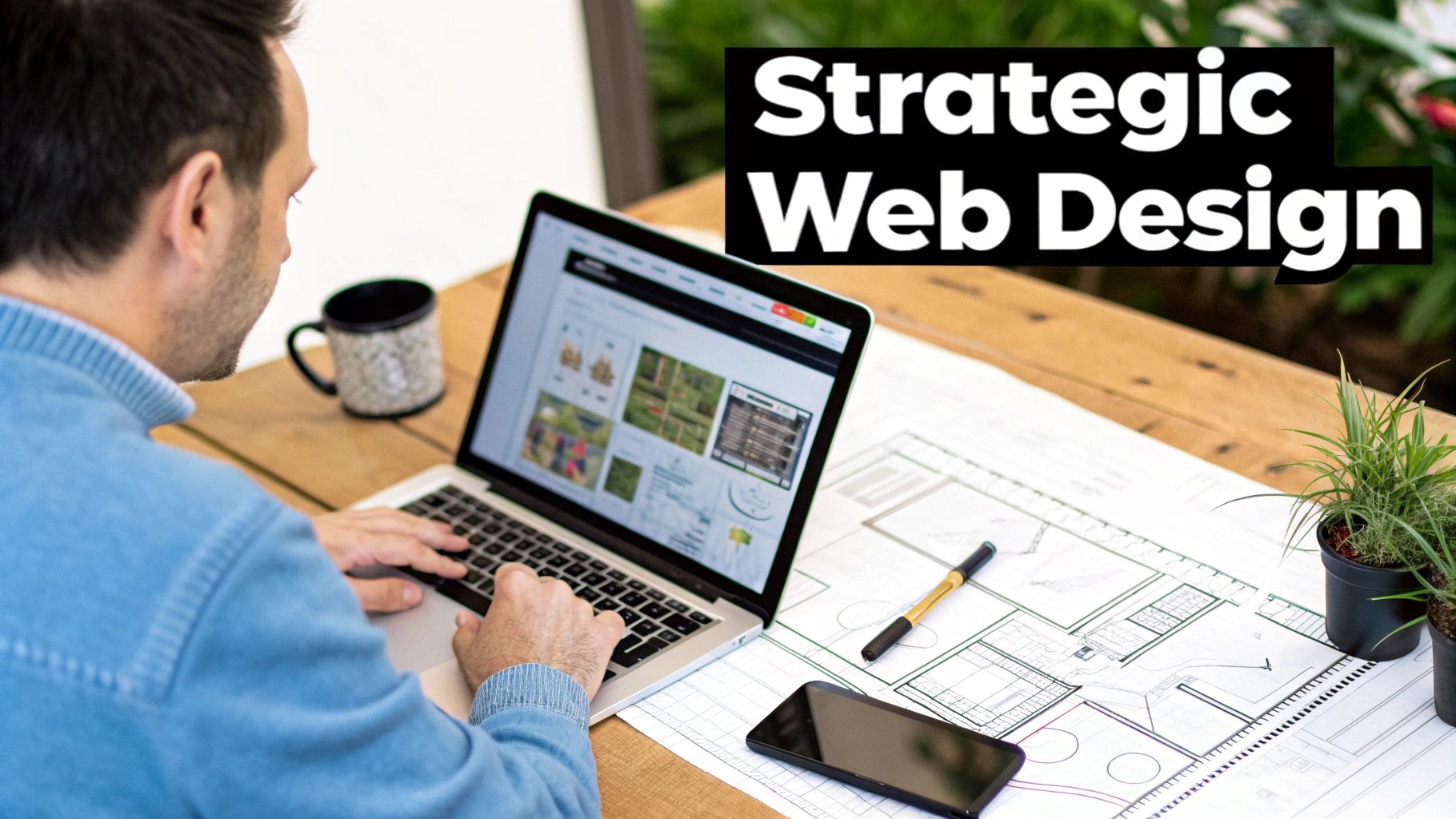
Too many business owners see their website as just a fancy business card—a place for a phone number and a list of services. That's a huge missed opportunity. Strategic small business web design takes that basic idea and turns it on its head. It shifts your site from a static, passive page into your hardest-working employee, one that never sleeps.
Think about it this way: a generic website builder is like a standard toolkit from a hardware store. It has the basics. A strategic design, on the other hand, is a custom-built machine, engineered from the ground up to do one job exceptionally well: grow your business.
It’s More Than Just a Pretty Picture
A visually stunning website that doesn't bring in a single lead or sale is, frankly, a waste of money. Real strategic design puts business results first. The aesthetics are there to support those goals, not the other way around. It’s all about creating a deliberate path for your visitors, guiding them from the first click to the moment they become a paying customer.
This all starts with understanding what your business actually needs. An NYC plumber who depends on emergency calls requires a completely different website than a local artist selling prints online. The plumber needs a huge, easy-to-tap "Call Now" button right at the top. The artist needs beautiful, high-resolution galleries and a simple, secure checkout process. The strategy dictates the design.
A strategic website doesn't just look professional; it performs as a 24/7 sales and marketing powerhouse that fuels tangible growth for your business. It actively works to bring you closer to your financial goals.
The Pillars of Strategic Design
A high-performing website isn’t the result of one magic bullet. It’s a careful blend of several key elements, all working in concert. These pillars are what ensure your site doesn't just sit there but actively helps your bottom line.
A successful strategic design always includes:
- Goal-Oriented Architecture: Every single page, button, and image has a purpose, whether it’s to get someone to fill out a form, buy a product, or book a consultation.
- Customer-Centric Experience: The website feels natural and intuitive to your ideal customer. It anticipates their questions and makes finding information effortless.
- Search Engine Optimization (SEO): From day one, the site is built to be found on Google. This isn't an afterthought; it's baked into the foundation to attract the right kind of traffic.
- Flawless Mobile Performance: With well over 60% of web traffic now on phones, your site absolutely must work perfectly on a small screen. It's no longer optional.
In the end, strategic small business web design is an investment in a system built to convert. It's about creating a digital engine that delivers a measurable return by attracting the right people and making it easy for them to do business with you.
The Core Components of a High-Performing Website
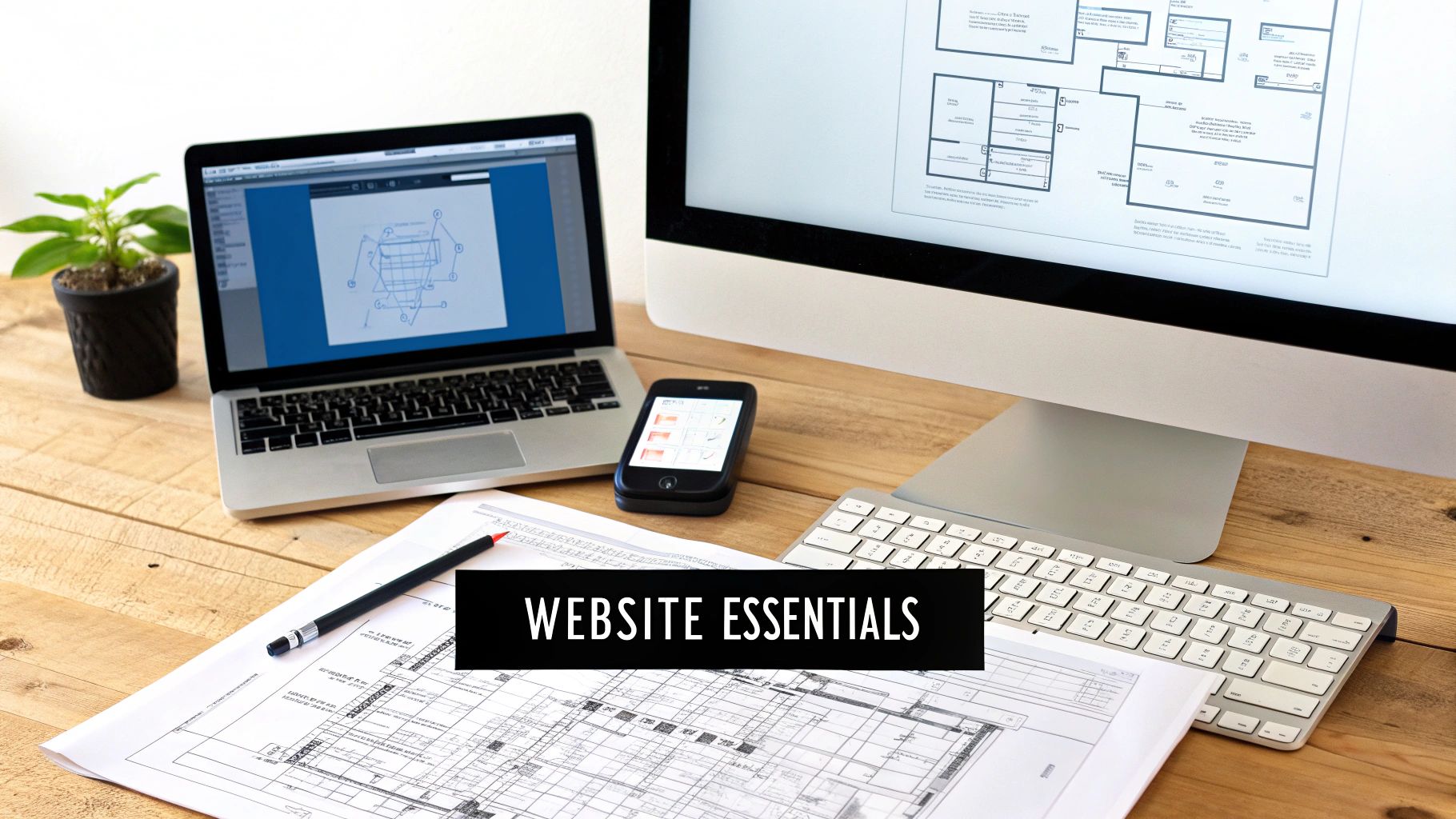
Breaking down what makes a website successful can feel a bit like learning a new language. But you don't need to become a fluent developer overnight. Once you get a handle on a few key concepts, you can talk about your project with confidence and make much smarter decisions.
Think of it like building a house. You need a solid foundation, a functional floor plan, a street address, and a way to manage everything inside. These core components are the building blocks for any effective small business web design, and each one plays a crucial part in making sure your site doesn't just look good, but actually works for your business.
User Experience Is Your Digital Blueprint
User Experience (UX) is the architectural plan for your website. This isn’t about picking colors or fonts; it’s about how the site feels to use. Is it easy to find what you're looking for? Is the navigation intuitive? A great UX guides a visitor seamlessly from the moment they land on your site to the moment they contact you.
Imagine walking into a grocery store where the milk is in the hardware aisle. You'd get frustrated and probably just leave. That's exactly what bad UX does to your website visitors—it makes them give up. Good UX builds trust and makes people want to do business with you.
Responsive Design Ensures You Look Good Everywhere
Responsive design is simply the practice of building a website that automatically adjusts to fit any screen, from a huge desktop monitor to a tiny smartphone. It’s like having a storefront that looks just as impressive on a highway billboard as it does on a business card.
This is no longer a "nice-to-have" feature; it's absolutely essential. With mobile devices now driving over half of all web traffic, a site that isn't mobile-friendly is actively shutting the door on a massive chunk of its potential customers. Google knows this, which is why it prioritizes mobile-friendly sites in search results.
The Content Management System: Your Control Panel
A Content Management System (CMS) is the software that acts as your website's control panel. It’s what lets you add blog posts, edit service descriptions, or swap out images without having to write a single line of code.
Think of it as the back office of your store. Customers see the polished shop floor, but you have access to the stockroom to update inventory and change the displays. Some of the most popular CMS options you'll run into are:
- WordPress: The giant in the room, powering over 43% of all websites. It’s known for its incredible flexibility and a massive ecosystem of plugins for just about anything.
- Shopify: The go-to platform for e-commerce. It’s built from the ground up to simplify product management and online sales.
- Squarespace: Famous for its user-friendly drag-and-drop interface and stylish templates, making it a great choice for portfolios and creative businesses.
A good CMS puts you in the driver's seat, allowing you to keep your website fresh and relevant—something both your users and the search engines will thank you for.
A well-chosen CMS empowers you to control your own digital destiny. It turns your website from a static brochure into a dynamic, evolving asset that you can update anytime.
Hosting and Performance: Your Digital Real Estate
If your domain name (your .com) is your website's street address, then web hosting is the plot of land your site is built on. It's the actual server space where all your website's files live. The quality of that "land" directly impacts your site's performance, especially its speed and reliability.
Site performance is non-negotiable in today's world. Slow-loading pages are a one-way ticket to a frustrated user and a lower search ranking. A fast, zippy site creates a better experience and gets rewarded by search engines. To dig deeper into the specific metrics Google uses, you can learn more about Core Web Vitals and their impact.
Technical SEO: The Unseen Foundation
Finally, there’s technical SEO. This is the foundation that your entire digital presence rests on. It’s all the behind-the-scenes work that makes it easy for search engines like Google to find, understand, and index your pages. For a site to perform well, it has to be discoverable, which is central to mastering SEO for your company.
This includes things you never see, like sitemaps, clean code, and fast server response times. You can’t see it, but it’s what makes your beautifully designed website visible to the rest of the world.
As more businesses grasp the value of a professional online presence, the numbers speak for themselves. By 2025, website ownership among U.S. small businesses is projected to hit 71–73%. This trend is fueling a massive market, with the web design industry estimated to be worth around $61.2 billion in 2025, proving a clear demand for expert-built websites.
How Performance and UX Translate to Real Revenue
It's easy to get lost in technical terms like "user experience" and "page speed," but these aren't just abstract concepts for designers. For a small business, they are direct lines to your bank account. The performance of your website and the experience it delivers aren't just expenses; they're some of the most powerful investments you can make in your company's growth.
Think of it like the line at your local coffee shop. If customers have to wait ten minutes just to order, many will simply turn around and walk out. Your website is no different. A slow, clunky, or confusing digital storefront costs you real customers and real money, often before you even know they were there.
The High Cost of a Slow Website
When it comes to small business web design, speed is everything. Every fraction of a second your site takes to load, you're losing potential customers. That isn’t an exaggeration—it’s a well-documented reality of how people behave online. A fast website feels professional and trustworthy; a slow one feels broken and unreliable.
This link between speed and perception has a massive financial impact. Research consistently shows that as page load time increases, the probability of a user leaving your site—what we call the bounce rate—skyrockets. When a visitor bounces, your chance of making a sale or getting a new lead from them drops to zero.
Shaving even a single second off your website’s load time can be one of the highest-return activities for your business. It directly reduces visitor frustration, improves search engine rankings, and boosts your conversion rate.
The data paints a stark picture of just how critical speed has become. Studies show that an increase in page load time from one to three seconds can raise the bounce rate by over 32%. If that load time stretches to ten seconds, the bounce rate can jump by a staggering 123%. This behavior leads to massive losses for businesses, and you can learn more about how these website design statistics impact business revenue.
Here's a quick look at how profoundly page speed affects visitor retention:
Impact of Page Load Speed on Visitor Behavior
| Page Load Time (Seconds) | Increase in Bounce Rate |
|---|---|
| 1s → 3s | +32% |
| 1s → 5s | +90% |
| 1s → 6s | +106% |
| 1s → 10s | +123% |
As you can see, the relationship is clear: the longer the wait, the fewer visitors stick around. This is lost opportunity in its purest form.
From a Good Experience to a Better Bottom Line
While speed gets visitors in the door, a great User Experience (UX) is what convinces them to stay and take action. Good UX is simply the art of making your website intuitive. It’s about ensuring customers can find what they need, understand what you offer, and move forward without any friction or confusion.
This is where so many businesses miss the mark. They might have a visually appealing site, but if the navigation is a maze or the "buy now" button is buried, they are creating roadblocks to revenue. Some small businesses even explore specialized options like outsourced UI/UX design services to ensure every click is effortless for their users.
Here’s how strong UX translates directly into financial gains:
- Increased Conversions: By making the path to purchase simple and clear, you remove the little frustrations that cause potential customers to abandon their carts or just give up.
- Higher Customer Loyalty: A positive, hassle-free experience builds trust and encourages repeat business. Customers remember how easy it was to work with you.
- Improved Brand Perception: A professional, easy-to-use website makes your business appear more credible and authoritative in your field.
The Unmistakable Power of a Clear Call-to-Action
Ultimately, every element of your site's performance and UX should lead the visitor to do one thing: take a specific, desired action. This is done with a powerful Call-to-Action (CTA). A CTA is a button or link that tells the user exactly what to do next, like "Request a Free Quote," "Shop Now," or "Schedule a Consultation."
Without a clear CTA, you're guiding a customer all the way to the finish line but never asking them to cross it. It’s the final, crucial step that turns a passive browser into an active lead or a paying customer. Your CTA should be impossible to miss, with compelling language that creates a sense of urgency and clarity. It’s the handshake that closes the deal.
What’s the Web Design Process Really Like?
Starting a professional web design project can feel like a huge undertaking, but it’s actually a pretty straightforward journey with clear, logical steps. Knowing what to expect turns it from something daunting into an exciting collaboration. The whole point of a structured process is to make sure what we build isn't just a website, but a genuine business tool designed to hit your specific goals.
A good agency will walk you through a predictable, multi-phase process. It’s all about making sure every single decision—from our first chat to the final launch—is deliberate and points directly at what you want to achieve.
Phase 1: Discovery and Strategy
This is the bedrock of the entire project, and honestly, it's the most important part. Before we even think about design, we need to get inside your business. That means having real conversations about your goals, who your customers are, what your competitors are doing, and what a "win" looks like for you.
The objective here is to nail down a crystal-clear strategy. Are we trying to get the phone to ring? Sell products online? Book appointments? The answers to these questions shape everything that comes next, ensuring the design is built on purpose, not just on pretty pictures.
Phase 2: Design and User Experience (UX)
Once the strategy is locked in, the creative work can start. But it doesn't begin with colors and fonts; it starts with structure. We'll first create wireframes, which are basically the architectural blueprints for your website. They map out the layout and how a user will move through the site, completely free of any visual distractions. If you're curious about this critical first step, we have a guide that explains how to create wireframes for websites in more detail.
After the blueprint gets your thumbs-up, we move on to mockups and prototypes. These are the full-color, high-fidelity versions of your site that show you exactly how it will look and feel. This is where your brand's personality—your colors, typography, and imagery—truly comes to life.
This design phase is a partnership. Your feedback is absolutely essential to make sure the final look not only wows but also connects with your customers and feels authentically you.
Phase 3: Development and Content Integration
With the final designs approved, our development team takes over. They translate those static visual designs into clean, functional code, building a fully interactive website. This is where the technical skill comes in, turning a great-looking concept into a real, working digital experience.
At the same time, we'll start weaving your content into the site. Your story—the words, photos, and videos that show people why you're great at what you do—gets carefully placed within the new design. We want to make sure your message is powerful, persuasive, and presented perfectly.
Phase 4: Testing and Launch
Before your new website sees the light of day, it goes through a ton of testing. We poke and prod every corner of it, checking for bugs, making sure it works flawlessly on every browser and device, and confirming that every button and link does what it's supposed to. This quality assurance phase is non-negotiable for a smooth launch.
Finally, once you give the green light, we launch the site for the world to see. But our job isn't done. A great partner won’t just toss you the keys and disappear. We’ll provide training so you feel confident managing your new site, empowering you to update content and make tweaks as your business evolves.
This step-by-step process is how we ensure your investment in small business web design pays off, giving you a powerful, goal-oriented asset built to last.
Real-World Examples of Successful Business Websites
Theory is great, but let's be honest—seeing how this stuff works in the real world is what really matters. A well-built website isn't just another line item on your budget; it’s an engine that can solve real business problems and deliver tangible results. So, let’s move past the concepts and look at how a smart approach helps different businesses right here in NYC achieve their goals.
Each of these examples breaks down a common business challenge, the specific design solution we built for it, and the results that followed. These aren't just pretty portfolio pieces. They're success stories built on strategic thinking.
The Local Contractor Who Needed More Leads
A local contractor came to us with a problem I’ve heard a hundred times: his old website looked like it was from another decade and wasn't bringing in any quote requests. This was especially true for homeowners searching on their phones. His goal was simple and direct: make the phone ring and fill up his schedule.
We knew right away that the solution had to be a complete overhaul with a mobile-first design. His customers are almost always on the go, looking for services while they’re out and about or even standing in the middle of a home improvement project.
The new design focused on a few key things:
- Prominent Click-to-Call Buttons: We put his phone number front and center in the header and made sure it was a big, tappable button that stayed put as you scrolled on a phone.
- A Simple 'Request a Quote' Form: We stripped the old, clunky form down to the bare essentials. The easier it is for someone to fill out, the more likely they are to do it.
- High-Quality Project Galleries: We let the work speak for itself with crisp, clear before-and-after photos. Nothing builds trust faster than showing what you can do.
The impact was immediate. In the first three months after launching the new site, he saw a 45% increase in qualified leads coming straight from the website. It was a perfect example of how focusing on the user's needs directly drives conversions.
The Professional Services Firm That Needed to Build Trust
When you're a law firm or a financial consultant, your website’s number one job is to build trust and establish authority. Their old site was a mess of industry jargon and had a confusing layout that left potential clients more confused than confident.
Our strategy was to create a clean, professional design that projected expertise and clarity from the moment the page loaded.
A professional services website must be an extension of the firm’s credibility. Its design should feel as dependable, clear, and trustworthy as the advice they provide to their clients.
We achieved this by building out clearly defined service pages that broke down complex topics into simple terms. We also added professional headshots and team bios to put a human face to the firm and featured client testimonials right on the homepage to provide powerful social proof. This new, organized structure didn't just feel better to users; it also gave their SEO a serious boost with keyword-rich, well-organized content.
The E-commerce Brand That Needed to Simplify Sales
An up-and-coming e-commerce brand had a classic problem: a sky-high cart abandonment rate. People were adding products to their cart but bailing before they ever clicked "buy." A quick look at their old site showed us why—the checkout process was a clunky, multi-step nightmare, and the product pages were just plain uninspiring.
Our mission was to create the smoothest, most frictionless path to purchase possible. We started by implementing a streamlined, one-page checkout that cut the number of steps way down. Then, we completely revamped their product pages with compelling, high-resolution images and copy that actually sold the product.
The result? A 20% decrease in cart abandonment and a significant jump in their overall online revenue. Sometimes, the simplest changes make the biggest difference.
How to Choose the Right Web Design Partner
Picking a partner for your small business web design project is a huge decision. Get it right, and the agency becomes a genuine extension of your team, steering you toward growth. But the wrong choice can mean blown deadlines, a website that falls flat, and a lot of wasted money. So, how can you spot the difference?
It starts with looking past the pretty pictures. A slick portfolio is great, but it’s only half the story. You need a partner who can prove they get results, not just design cool-looking layouts. When you look at their past work, don't just ask, "Is this nice?" Instead, ask, "Does this look like it actually works?" You should see obvious calls-to-action, navigation that makes sense, and designs that are clearly built to achieve a specific business goal.
Analyzing a Potential Partner
To really get a feel for an agency, you have to dig into their process and their way of thinking. A good partner will be open and honest, think strategically, and stay focused on your return on investment. Those first few conversations are your golden opportunity to see if you're on the same page.
When you sit down with potential agencies, have your questions ready—and make sure they go deeper than just "how much?" and "how long?" You're trying to figure out how they approach problems and what success looks like to them.
Here are a few essential questions to get the ball rolling:
- How will you measure the success of my new website? Their answer should be about tangible results like conversion rates, new leads, or online sales, not just vague metrics like traffic.
- What's your process for communication and collaboration? You need a partner who keeps you in the loop with regular updates, not one that goes silent for weeks on end.
- Can you show me a case study for a business like mine? This is the best way to see if they've already solved the kinds of challenges you're facing.
- Who will be my day-to-day contact for this project? A dedicated project manager means clear communication and accountability, which keeps things running smoothly.
Choosing a web design partner is like hiring a key employee. You're not just buying a product; you're investing in a long-term relationship built on trust, communication, and a shared commitment to your business goals.
The Value of a True Partnership
Remember, your website isn't a "set it and forget it" task. It's a living part of your business that has to grow and change right along with you. That's why the smartest move is finding a partner who offers support long after the launch. Think ongoing SEO, performance monitoring, or help launching new marketing initiatives.
For businesses here in NYC, finding a partner with serious local SEO chops is non-negotiable. They'll get the nuances of our market and know exactly how to get your business in front of local customers. In a city this competitive, that local focus can be the thing that puts you ahead. For a more detailed breakdown, our guide offers more tips on how to choose a web design agency that fits your specific needs.
At the end of the day, you're looking for a team that's as invested in your success as you are. They should feel like a real partner, someone who celebrates your wins and is always looking for new ways to help you improve. If you go in with the right questions and a clear idea of what you need, you’ll find a team that builds more than just a website—they’ll build a powerful engine for your company's future.
Got Questions About Small Business Web Design? We've Got Answers.
Stepping into the world of web design can feel a little overwhelming. We get it. Business owners often ask us the same key questions, so we’ve put together some straightforward answers to help clear things up.
How Much Should a Small Business Website Actually Cost?
This is the big one, isn't it? The honest answer is: it depends. A professional, custom-built website typically starts at a few thousand dollars and can go upwards of $10,000.
Think of it like buying a car. A reliable sedan gets you from A to B, but a custom-tuned sports car with all the bells and whistles is in a different price league. A simple "brochure" website will be on the lower end, while a complex e-commerce store with custom features will naturally cost more. The final price tag is all about the complexity, the features you need, and the level of custom design work involved.
How Long Does It Take to Build a New Website?
Patience is a virtue, especially here. A typical small business website takes about 6 to 12 weeks from our first conversation to launch day. This isn't just about coding; this timeline gives us the breathing room to do things right—strategy, design, development, and thorough testing.
Could it be done faster? Sure, but rushing often means cutting corners on the things that matter most, like user experience or foundational SEO. And that's a recipe for a site that doesn't perform.
Building a website isn't just a technical task; it's a strategic one. A realistic timeline ensures every decision is purposeful and aligned with your business goals, preventing costly mistakes and rework down the line.
Can't I Just Use a DIY Website Builder Myself?
You absolutely can. Platforms like Squarespace or Wix are fantastic tools, especially if you're just starting out or on a really tight budget. They get you online, and that’s a great first step.
However, the trade-off is often control. These platforms can have real limitations when it comes to custom design, advanced SEO, and the ability to scale up as your business grows. A professionally built website gives you total freedom and is designed from the ground up to hit specific business goals, like generating leads or driving sales.
What Do I Need to Have Ready to Get Started?
To hit the ground running, the most important thing you can bring is a clear vision for what you want this website to do for your business. Are you trying to get more phone calls? Sell products? Book appointments?
It's also super helpful if you have your branding materials (like your logo and brand colors) and any content you already have (text, photos, videos). The more you can tell us about your ideal customer and your competitors, the better we can craft a website that truly works for you.
Ready to build a website that drives real results for your business? The team at Web Design at NY specializes in creating custom, high-performing websites designed to help NYC small businesses grow. Get your free quote today!